
A320: Four Seconds When Three Hydraulic Systems Lost Pressure
Air India AI2379 was operating from Phuket to Delhi on 4 August 2026. At FL360, the flight-control system detected a loss of pressure in the Green hydraulic system. Four seconds later, indications of pressure loss also appeared in the Blue and Yellow systems.
The autopilot disconnected, a brief stall warning occurred, and the aircraft first climbed above its assigned level and then descended below it. Within seconds, hydraulic pressure began to recover, flight-control operation returned to normal, and the aircraft continued to Delhi, landing safely at 05:30 UTC.
The central engineering question is not simply how an A320 can lose hydraulic pressure. It is how three separate hydraulic systems could register pressure loss within seconds of one another — and why the pressure then recovered.
1. Three hydraulic systems instead of one
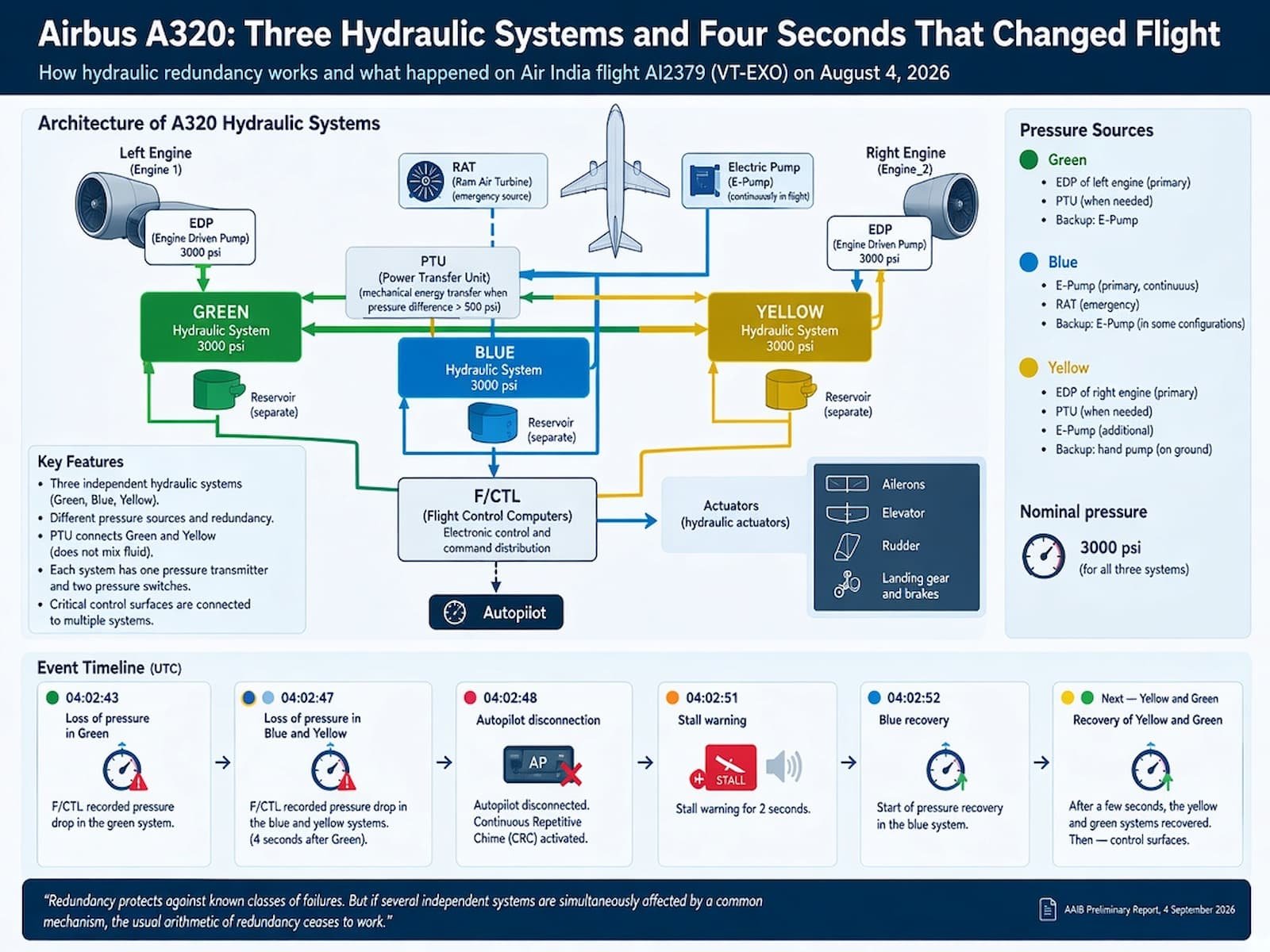
The A320 hydraulic architecture is built around three separate systems: Green, Blue and Yellow.
Each has its own reservoir and hydraulic circuit. Hydraulic fluid does not transfer between the systems. Nominal pressure for the main users is 3000 psi, approximately 206 bar.
This architecture distributes pressure sources and allows the aircraft to retain flight-control capability following individual failures.
2. Where the pressure comes from
In normal operation, Green is pressurised by the engine-driven pump of the left engine.
Yellow is normally pressurised by the engine-driven pump of the right engine.
Blue uses an electrically driven pump as its normal source.
Additional sources provide redundancy: the PTU mechanically couples Green and Yellow without transferring hydraulic fluid between them, while Blue has the RAT as an emergency source. The exact source configuration depends on the aircraft operating condition.
3. Redundancy does not mean one combined system
A key feature of the architecture is that the three systems remain separate. The PTU can transfer mechanical power between Green and Yellow when the required pressure difference exists, but it does not transfer hydraulic fluid from one system to the other. Therefore, the recorded sequence of pressure loss in Green, Blue and Yellow cannot by itself be explained simply as hydraulic fluid moving between systems. Establishing the physical mechanism requires analysis of the relevant components and flight data.
4. What happened in four seconds
At 04:02:43 UTC, the flight-control system detected a loss of pressure in Green. Approximately four seconds later, pressure-loss indications were detected in Blue and Yellow as well. At 04:02:48 UTC, the autopilot disconnected. At 04:02:51 UTC, a stall warning occurred for approximately two seconds. Hydraulic pressure then began to recover.
5. The aircraft moved outside its assigned level
After the event began, the aircraft climbed approximately 372 ft above its assigned level and subsequently descended approximately 292 ft below it. The total vertical excursion relative to the assigned level was therefore about 664 ft. This formed part of the short-lived disruption of aircraft control following the pressure-loss indications and autopilot disconnect.
6. What hydraulics mean for flight control
On the A320, hydraulic power is used by the actuators that move the primary flight-control surfaces. When hydraulic pressure is lost, the availability of those actuators and the behaviour of the flight-control system are affected. During this event, the pressure-loss indications were followed by autopilot disconnection and flight-control fault messages, including FLT CTL L,R ELEVATOR FAULT. The event therefore went beyond a hydraulic-system indication and directly affected aircraft control.
7. Then the hydraulic systems began to recover
At approximately 04:02:52 UTC, pressure recovery began in Blue. Yellow and Green subsequently recovered, followed by recovery of the flight-control surfaces. The aircraft continued the flight and subsequently landed safely in Delhi at 05:30 UTC.
8. Why the recovery matters
The combination of pressure-loss indications in all three systems followed by recovery within seconds is a central feature of the event. It does not, however, establish a specific cause. The preliminary report does not determine which physical mechanism produced the sequence of pressure-loss indications. Possible explanations require correlation of flight-recorder data, removed component condition, hydraulic-fluid samples, technical documentation and maintenance history.
9. The aircraft was already operating under MEL
The pre-flight inspection found no new discrepancies, but the aircraft was operating with an existing MEL item, 29-23-01A, related to the PTU. This MEL item had been invoked on 28 July 2026. The fact that the aircraft was operating under MEL does not by itself establish a causal connection with the subsequent event. Any relationship between the PTU status and the pressure loss in all three systems remains a matter for the investigation.
10. What the recorded indications showed
The post-flight report recorded HYD GREEN SYS LO PR, followed by BLUE and YELLOW, AUTO FLT AP OFF, as well as flight-control fault messages and low-level indications in the hydraulic reservoirs. Each hydraulic system uses one pressure transmitter and two pressure switches for pressure monitoring. The investigation therefore needs to correlate the different pressure-monitoring channels with the actual condition of the removed components.
11. Damage inside the cabin
Several cabin components were damaged during the event, including overhead ceiling panels, PSU panels, a handrail, an emergency-exit handle, overhead-bin doors and other fittings. Twenty-four people were injured: 20 passengers and 4 cabin crew; four were hospitalised with serious injuries. After the event, the aircraft remained capable of taxiing under its own power and landed in Delhi.
12. What remains unknown
The preliminary report does not establish the root cause of the event. AAIB is continuing to analyse flight-recorder data, technical and operational records, the condition of hydraulic components and fluid samples. Airbus technical experts are also involved in the analysis. It is therefore not possible at this stage to state that the cause was a hydraulic leak, PTU malfunction, pump failure, pressure-sensor error or software problem.
13. The engineering meaning of the case
The case is interesting because it illustrates the boundary between redundancy and common-cause failure. Three separate hydraulic systems provide substantial protection against individual failures. But if a single mechanism, event or condition affects several independent channels at the same time, channel separation alone may no longer provide sufficient protection. It is not yet known whether such a common mechanism was involved in AI2379. That remains one of the central questions of the investigation.
14. The investigation continues
At the time of publication, the available source is the AAIB preliminary report. Its purpose is to establish facts and prevent recurrence, and its findings may change as additional evidence becomes available. The final technical cause of the event should therefore be assessed only after completion of the investigation.