
Mining & Engineering Cases: When One Replacement Is Not Enough
The same pilot valve 7-182208-805 was used for two different functions on mining equipment. After the original valve became obsolete, no single direct replacement was available for both functions. This example shows why replacing an obsolete component sometimes starts not with finding a new part number, but with understanding the function the original component performed within the system.
THE OBSOLETE PART: ONE VALVE — TWO FUNCTIONS
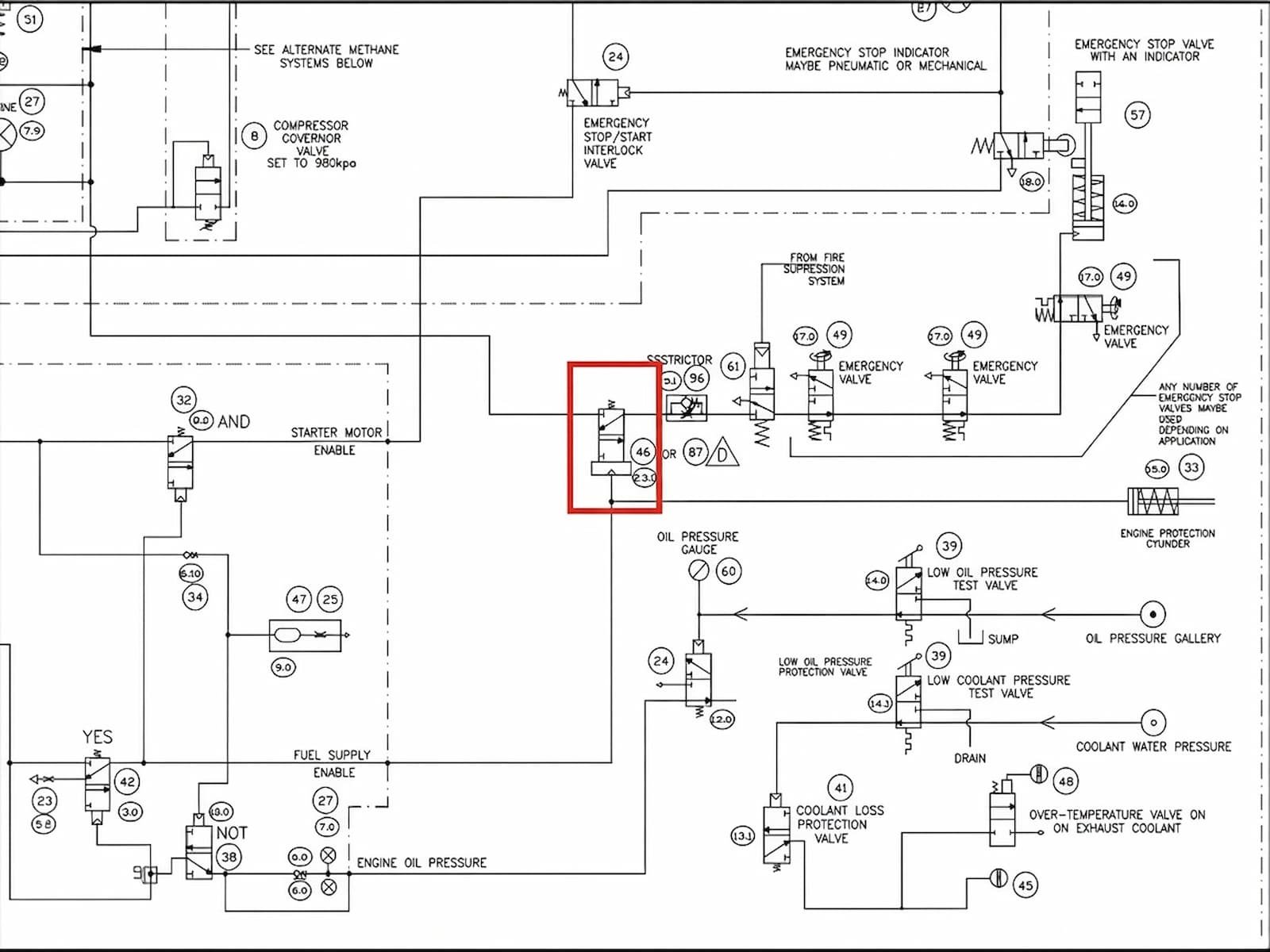
Pilot valve 7-182208-805 was used in the MWM Engine package and performed two different functions.
As the Strangler Pilot Valve, it provided the pilot signal to the emergency stop valve when the safety circuit was healthy. As the DPF Backpressure Valve, it was used to monitor diesel particulate filter backpressure. This is why, after the original valve was withdrawn from use, the manufacturer could not provide a single direct replacement suitable for both applications.
WHEN THE PART NUMBER STOPS BEING THE ENGINEERING PROBLEM
At first glance, an obsolete component appears to be a conventional replacement-part sourcing problem. In this case, however, searching for an identical valve by part number does not solve the problem: the original component performed two different functions within the system. The engineering task therefore begins with a different question — what function does this component perform in the specific machine, and which system parameters must be preserved after replacement?
TWO APPLICATIONS — TWO SOLUTIONS
For the Strangler Pilot Valve, Cougar specifies replacement 7-162007-700 together with fitting kit 7-630358-700. For the DPF Backpressure Valve, AR00160 is used together with fitting kit 7-630357-700. AR00160 can be configured for either a DPF backpressure alarm arrangement or a DPF backpressure shutdown arrangement, with different hose configurations for the two applications. The replacement is therefore determined not only by the valve itself, but also by its specific function and method of integration into the system.
REPLACEMENT IS NOT ALWAYS PLUG-AND-PLAY
In this case, the replacement involves more than the main component. Separate fitting kits are specified for the new valves, and installation of AR00160 on Predator and MineCruiser Mk7/Mk8 machines requires a 20 mm mounting hole. This illustrates the practical boundary between an ordinary spare-parts replacement and an engineering retrofit: mechanical, pneumatic and functional interfaces have to be considered as one system.
BESTFLOW ENGINEERING VIEW: REPLACE THE FUNCTION, NOT JUST THE PART
For obsolete equipment, searching for a replacement by part number alone may not be sufficient. The first step is to establish the original component's function, its position within the system, the type and configuration of its interfaces, the required operating parameters, and the mechanical mounting arrangement.
Only then can it be determined whether a direct replacement exists, whether an adaptation of an existing component is required, or whether the task has already become an engineering retrofit.
This is why an obsolete-part problem is often not a sourcing task, but an engineering task.